
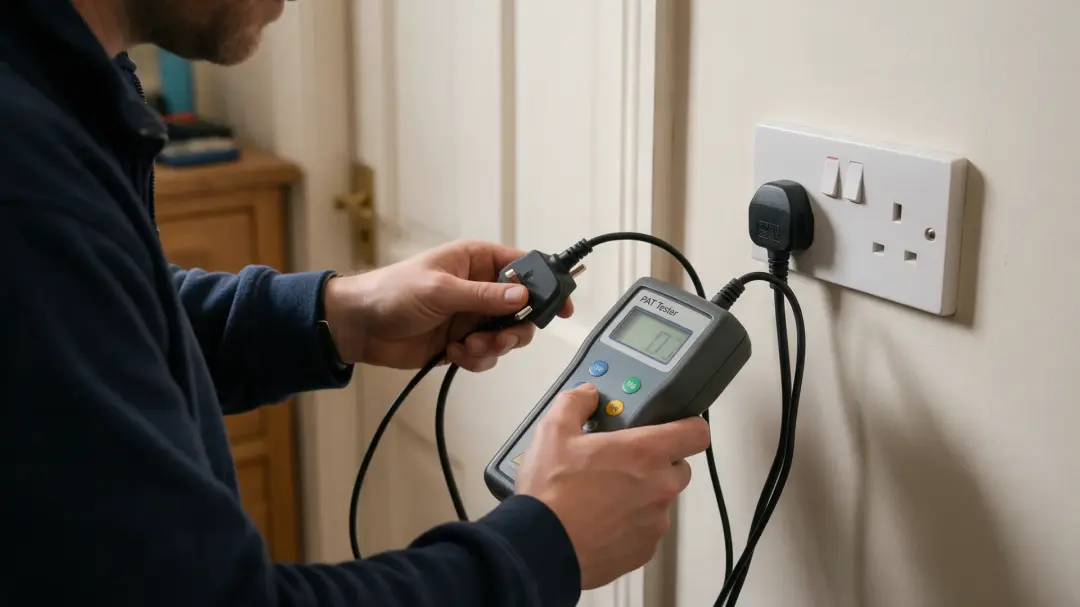
Who Can Carry Out PAT Testing?
Research checked: 5 October 2026.
PAT testing should be performed by someone competent for the work involved. That person does not necessarily have to be an electrician, but owning a tester or attending a short course is not enough evidence on its own. The appropriate knowledge and practical ability depend on the equipment, test methods and setting.
For an organisation in Holbeach, choosing a provider means checking what they can assess and how their findings will be explained. A useful appointment begins with an equipment scope and a realistic account of its use, not simply a request for a number of pass labels.
What competence means in practice
HSE says competence for electrical work depends on task complexity. It identifies appropriate training, experience of comparable work and regular reassessment as evidence to consider. People unable to demonstrate competence need suitable supervision. HSE guidance on electrical competence.
For PAT testing, ask how the person determines which assessment is appropriate and how they interpret unexpected results. You are looking for a reasoned approach rather than an automatic sequence applied to every device. A provider should recognise the limits of their work and be prepared to refer an unfamiliar or specialist item to someone with the necessary expertise.
Competence also includes explaining a limitation. If a particular appliance cannot be assessed under the agreed arrangements, the report should make that clear rather than turning an incomplete examination into a pass.
Which checks can trained staff undertake?
HSE's PAT FAQ distinguishes trained staff visual inspections in many low-risk environments from combined inspection and testing, which requires greater knowledge and experience. The tester needs suitable equipment, the ability to use it correctly and the ability to understand its results. HSE explanation of who can inspect and test appliances.
A staff reporting scheme can be valuable alongside a contractor visit. Give employees a clear route for concerns and explain that they should not dismantle or repair items beyond their competence. A nominated equipment manager can gather reports and arrange assessment without expecting every employee to become an electrical specialist.
Keep the responsibilities specific. A person checking visible condition is not necessarily authorised to undertake repairs, change supply arrangements or certify fixed wiring. The organisation should know who can do which task and where further assistance is required.
A training certificate is only one part of the decision
Ask about relevant training, recent practical experience and the types of equipment normally assessed. A general course may be a useful foundation, but it does not establish competence for every specialist appliance. Describe unfamiliar equipment before the visit so suitability can be discussed in advance.
The provider's approach to instruments also matters. Ask how the equipment's suitability and accuracy are maintained and how identifiable results are recorded. Avoid setting an arbitrary universal calibration interval yourself; the provider should explain its instrument-control arrangements and the applicable manufacturer's requirements.
You can request a sample report with private details removed. It should help you understand what a result means and how a failed or untested item is identified. If the report is only an unexplained list of numbers, ask how the responsible manager will receive an understandable handover.
Why DIY confidence does not demonstrate technical skill
The IET's 2026 household campaign reports that 27% of people attempt socket changes. Its survey concerns home behaviour, not workplace PAT providers, and cannot measure a contractor's competence. It does illustrate why willingness to attempt an electrical task should not be confused with evidence of capability. IET 2026 findings on household electrical DIY.
The distinction is relevant when deciding whether an employee should take on testing in-house. Interest, confidence and a newly purchased instrument do not settle the question. Assess the actual task, provide appropriate training and supervision, and consider whether an experienced external provider is a better fit for the equipment involved.
Testing itself must be organised safely
HSE's electrical-testing guidance addresses risks to those carrying out tests and people nearby. Planning the activity and selecting suitable precautions form part of the work. HSE guidance on safety in electrical testing at work.
Agree a suitable working arrangement before the appointment. Identify equipment in public areas, items serving essential operations and any access restrictions. Discuss disconnection with the relevant manager rather than assuming everything can be unplugged on arrival. Clear coordination helps prevent avoidable interruptions and gives the tester a controlled setting.
Do not expect PAT testing to cover unrelated building defects. A loose socket, damaged circuit or concern about fixed wiring needs its own assessment. Similarly, specialist equipment may require a maintenance process extending beyond an ordinary portable-appliance visit.
What to ask before booking a provider
Explain the number and types of appliances, their locations, detachable leads and any known faults. Ask which items the quotation includes, how unavailable equipment is handled and what follow-up is offered for failures. Establish whether repairs are included or require a separate decision.
Discuss the format of the equipment register and the handover. You should be able to identify each item and understand any action required. Ask who will recommend review arrangements and what information they need about use and environment. A clear scope reduces disagreement about an item omitted from the visit or a separate lead assumed to be included.
For premises in Market Deeping as well as Holbeach, flag access times early and nominate someone who can answer equipment questions on the day. That preparation makes the provider's competence easier to put into practice.
Summary
Choose a PAT provider on demonstrated suitability for the task: relevant knowledge, practical experience, appropriate instruments and understandable reporting. Trained staff can contribute within their competence, while more technical work needs the corresponding expertise. Discuss your Holbeach equipment and working arrangements with Robert Bowman Electrical Contractor before agreeing the testing visit.