
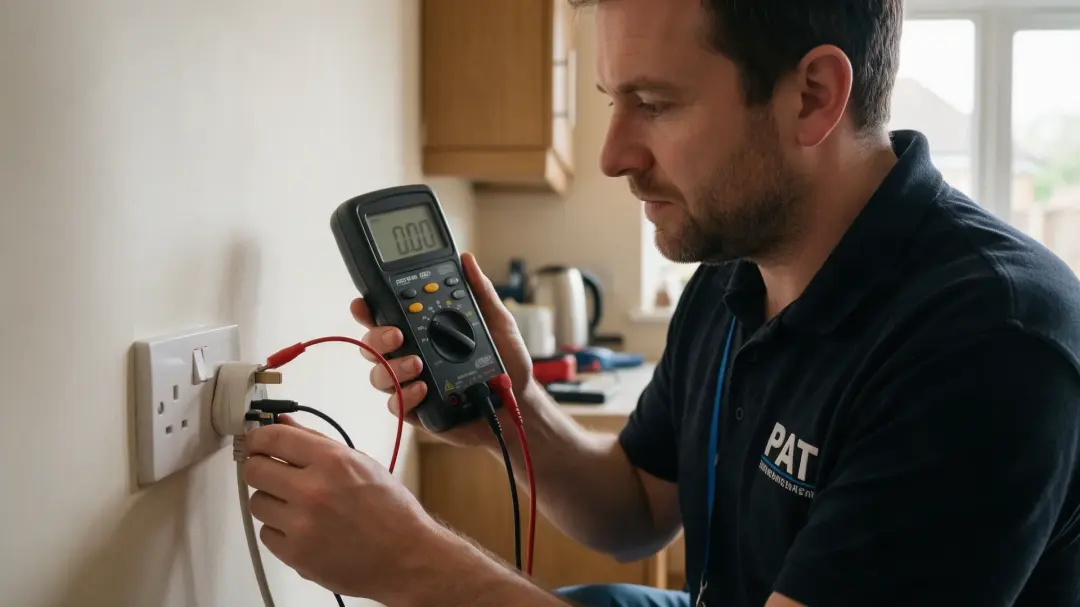
How Often Should Appliances Be PAT Tested?
Research checked: 5 October 2026.
There is no single PAT testing interval that suits every appliance. A stationary office printer, a cleaner's vacuum and a frequently transported tool face different conditions. The right programme considers how damage could occur and how quickly it would be noticed, then uses inspection findings to review the arrangements.
If you manage premises in Holbeach or Long Sutton, begin with the equipment and its working environment. For enquiries about North Lincolnshire locations, provide the premises address so Robert Bowman Electrical Contractor can confirm availability and discuss the proposed service before arrangements are made.
Separate everyday checks from formal testing
An equipment programme has several opportunities to notice a problem. Staff may identify damage during ordinary use; a planned visual inspection looks more systematically; combined inspection and electrical testing addresses the items for which it is appropriate. These activities should not be treated as interchangeable appointments.
A date on a label records a past assessment. HSE's low-risk guidance explains that a test indicates condition at the time and does not guarantee safety for a future period. HSE guidance on the limits of a PAT result. If the cable is damaged the following week, the remaining months before the printed date do not make continued use acceptable.
Published intervals are starting examples
For low-risk environments, HSE's INDG236 suggests initial formal visual inspections every two to four years for desktop computers; combined inspection and testing may extend up to five years for relevant earthed equipment. For earthed kettles and some floor cleaners, it suggests visual inspection at six to twelve months and combined testing at one to two years. These are examples, not legal deadlines. HSE table of suggested initial intervals.
Apply the table only within its stated low-risk context. An office appliance repeatedly moved to events may no longer fit the assumptions of equipment that stays on a desk. A kitchen item used by many people can have a different history from a similar item in a small, carefully managed office. Where the classification or setting is uncertain, ask a competent person to assess it.
Movement, moisture and rough use change the assessment
Think about the appliance's actual journey through a working day. Is it carried between rooms, put in a vehicle, pulled by its lead or stored where other equipment can damage it? Does its location expose it to spills, cleaning chemicals or heavy dust? Those details are useful when agreeing review intervals.
Describe use accurately when requesting a quotation. A contractor cannot infer the handling history from the model number alone. Include seasonal equipment and items used only occasionally, because storage can create its own problems. A seldom-used item is not automatically safe simply because it spends much of the year disconnected.
Where people work at several sites, decide who reports damage and who controls the equipment register. Otherwise, an appliance can move beyond the local manager's view without its history following it.
Read related articles:
How Long Does House Rewiring Take?
Who Can Carry Out PAT Testing?
Is PAT Testing a Legal Requirement?
A recent reminder about seasonal equipment
Electrical Safety First reported in March 2026 that England recorded 31 accidental electric-blanket fires in 2024/25, compared with 25 in 2023/24: a 24% increase. These small annual totals concern one product type and are not PAT failure rates. Electrical Safety First analysis of electric-blanket fires.
The example is a reminder to review equipment coming out of storage. A seasonal appliance's calendar interval is only part of the story; its condition, instructions and suitability still matter when it returns to use. A routine test must not be presented as proof that every possible internal product problem has been excluded.
Use findings to adjust the programme
Look at the history for each meaningful group of equipment. Repeated damaged leads on cleaning appliances suggest that their use and handling need review. A consistently quiet fault history may support discussion of a different interval, but the decision should still account for the consequences of a missed defect.
HSG107 identifies risk assessment as the basis for examination frequency and makes clear that suggested intervals are not statutory requirements. HSE advice on deciding examination frequency. Ask the provider to explain its recommendations and retain the reasons behind your decision. An interval copied from a previous business may have no useful connection with your present equipment.
Do not wait for the diary when something changes
New premises, a different work activity, a repair or a change in users can justify reviewing arrangements before the next planned visit. Tell the testing provider what has changed and ask whether the existing scope still fits. A clear trigger for review is easier to manage than relying on someone remembering every assumption made years earlier.
When damage is reported, keep the item out of service pending competent assessment. Agree how it will be identified so another employee does not simply plug it back in. Any repair and subsequent assessment should be recorded against the same equipment identity, maintaining a usable history rather than creating an apparently unrelated entry.
Building a manageable schedule
Group appliances where their risks and access arrangements are similar. Decide who gathers equipment, identifies detachable leads and gives access to locked rooms. Agree how items missing from the visit will be followed up; an incomplete list should not silently become the new register.
Schedule testing around the operations that genuinely need continuity. Provide an inventory before the visit where possible and flag equipment needing special arrangements. The useful result is a maintainable programme with clear responsibilities, rather than the largest possible number of labels applied on a single day.
Summary
Set intervals from equipment risk and review them against actual findings. Keep checks between visits, investigate new damage promptly and use HSE's published examples within their proper context. Ask Robert Bowman Electrical Contractor about PAT testing for your equipment list and confirm service availability for the premises concerned.