
Benefits of LED Lighting Installation
Research checked: 5 October 2026.
LED lighting can reduce electricity use while giving you more choice over the way a room feels. The worthwhile upgrade is not simply the greatest possible number of new fittings. It is an arrangement that provides the required light, works with appropriate controls and can be maintained sensibly.
For a Spalding home or premises in Moulton, first identify what the existing lighting does poorly. High running costs, uneven worktop light or difficult lamp changes are different problems. A lighting installation can address them together, but the proposed specification should make the benefits clear.
Lower electricity use for comparable light
Energy Saving Trust's lighting guide, last updated in August 2025 and checked for this article in October 2026, states that LED bulbs use 80% less electricity than halogen bulbs for comparable light. It estimates that replacing a home's remaining halogen spotlights could save £45 annually in Great Britain. Those are published estimates, not a saving guaranteed for every property. Energy Saving Trust guidance and savings estimates.
The result at your property depends on the lamps replaced and how long they operate. Replacing fittings that are rarely used offers a different return from upgrading a kitchen where the lights are on for several hours each evening. If you already have suitable LEDs, adding more fittings can increase consumption rather than reduce it.
Ask the installer to describe the proposed lamp or fitting power and intended coverage. A clear before-and-after comparison is more useful than an efficiency claim without a description of the installation.
A worked example with the assumptions visible
Suppose six 50-watt lamps are replaced with six suitable 5-watt LEDs, each operating for 1,000 hours a year. The older set uses 300 kilowatt-hours annually; the replacement set uses 30. The difference is 270 kilowatt-hours, a 90% reduction for this particular example.
At an illustrative electricity unit price of 28 pence per kilowatt-hour, that difference would be £75.60 a year. This is our calculation, not a current tariff quote or a national household statistic. It excludes installation costs and assumes that the selected LEDs deliver appropriate light in the existing arrangement.
Use your own tariff and operating hours when assessing a proposal. The calculation is power in kilowatts multiplied by operating hours, then multiplied by the unit price. A contractor can help compare the actual fittings rather than treating the example as a prediction for your rooms.
More useful light where you need it
An LED upgrade creates an opportunity to correct the placement of light. A kitchen may need illumination along preparation surfaces rather than a brighter central fitting. A reading corner may benefit from a controlled task light instead of increasing brightness throughout the room.
Discuss the working surface, furniture and viewing positions before deciding the layout. Direction, diffusion and control affect the result as much as the headline output. A fitting that exposes its light source directly to seated occupants can feel uncomfortable even if the room appears bright.
For mixed uses, divide the room into practical groups. Preparation lighting, dining lighting and general illumination need not operate together. That flexibility lets the installation support different activities without making every evening feel like the same setting.
Maintenance and choosing a replaceable system
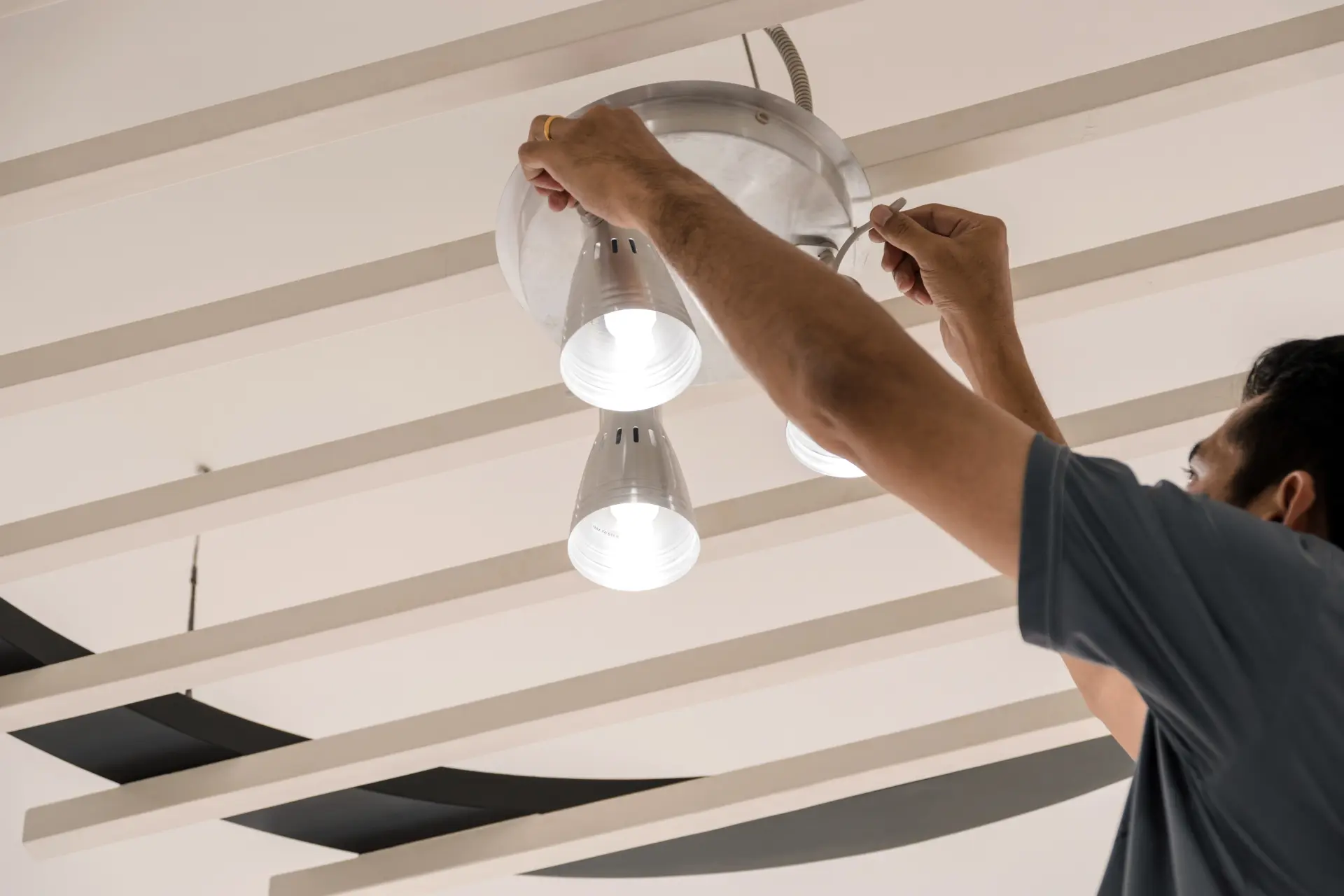
LED products can reduce the frequency of lamp changes compared with older lighting, but expected life and service arrangements vary. Read the product's stated lifetime, warranty and replacement information. Ask whether a failure involves changing a lamp, a driver or the entire fitting.
An integrated fitting may offer a neat result, while a fitting with replaceable lamps may suit someone who values straightforward future replacement. Neither format is automatically the best choice for every room. Discuss access above ceilings, matching replacements and any special components before the installation is agreed.
For high or awkward positions, maintenance access deserves particular attention. The initial fitting cost is only part of ownership. A readily supported product can be more practical than a decorative model whose replacement parts are difficult to obtain later.
Dimming and controls need compatibility
Not all LED lamps are dimmable, and a dimmable lamp still needs compatible control equipment. Energy Saving Trust advises checking compatibility and consulting an electrician when upgrading a dimmer. Advice on LED dimmer compatibility. Flickering or poor adjustment is a reason to assess the combination rather than repeatedly changing random parts.
Tell the installer how you want the room to behave. Do you want gradual dimming for evenings, separate working light or a simple two-switch arrangement? Check that everyone using the space can understand the controls. A complicated app-only system can make an efficient installation inconvenient for guests or household members.
A lower-power lamp does not remove installation requirements
Changing a suitable replaceable lamp and altering a fixed fitting are different tasks. For a new layout or replacement fixed fittings, discuss the existing circuits and mounting arrangements with an electrician. Bathrooms and exposed outside positions need their own suitability assessment.
Provide product information before purchase where possible. Include the location, proposed controls and any existing transformers or drivers. A lamp that fits the opening is not necessarily compatible with everything behind it. Ask what inspection, testing and documentation belong to the agreed electrical work.
During a wider renovation, coordinate positions with ceilings, cabinetry and decoration. Agreeing details before surfaces are finished reduces the likelihood of installing a fitting that later conflicts with a cupboard door or leaves the actual task area in shadow.
Deciding where to start
List the lighting that is used most often and the areas where visibility is poor. Then prioritise replacements that solve a real problem and have clear running-cost or maintenance benefits. A staged upgrade can be sensible if you do not need a complete redesign.
For premises in Bourne, identify working hours and explain whether installation must be coordinated with occupied areas. Ask for a proposal that separates fittings, controls and electrical work so you can assess the intended result against the budget.
Summary
LED lighting offers lower consumption and flexible design when the products and layout are chosen well. Compare realistic usage, check control compatibility and consider future maintenance. Contact Robert Bowman Electrical Contractor about lighting installation in Spalding to discuss an LED upgrade that improves the spaces you actually use.